
Unreliable Stories of Famous Dishes No 3.
Eggs Benedict, Lobster Newburg and Baked Alaska.
You have no doubt, heard of Eggs Benedict, Lobster Newburg and Baked Alaska, but you probably wouldn’t have heard of the chef who created all three dishes, Charles Ranhofer. For a chef to create one world famous restaurant dish in his working life is quite an achievement, but to create three iconic restaurant dishes is unusual, to say the very least.
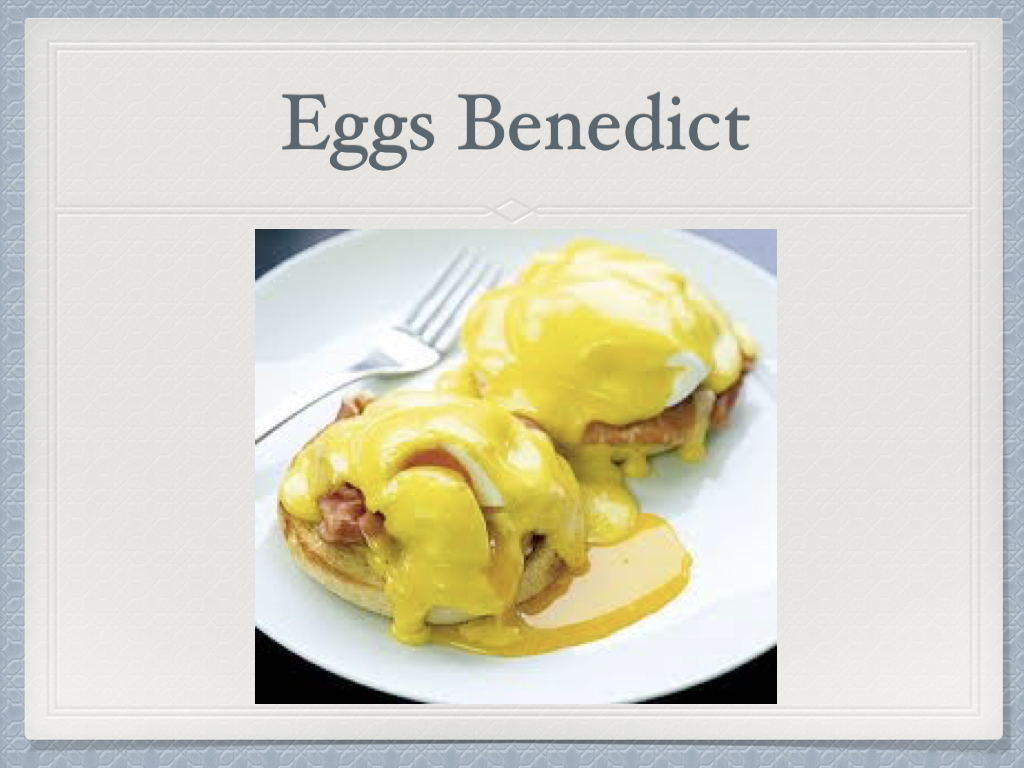
EGGS BENEDICT
Eggs Benedict is a muffin sliced through the middle and toasted, with a thick round of cooked ham and a soft poached egg placed on top of each half, and served covered with Hollandaise sauce.
Charles Ranhofer was the head chef at Delmonico’s Restaurant in New York. Ranhofer was born in St-Denis, France, into a restaurant dynasty. Both his grandfather and his father were chefs and owned restaurants in France, where Charles learnt his craft. But Charles felt this destiny lay elsewhere. In 1860 at the age of twenty, he sailed to America, as chef to the Russian consul in New York. Possibly through the Consul’s widely publicised banquets in the press, and society gossip, it didn’t take long before he gained the reputation as one of the most sought after chefs in New York. Very soon he was poached (pun intended) and hired by Lorenzo Delmonico as head chef at Delmonico’s in New York.
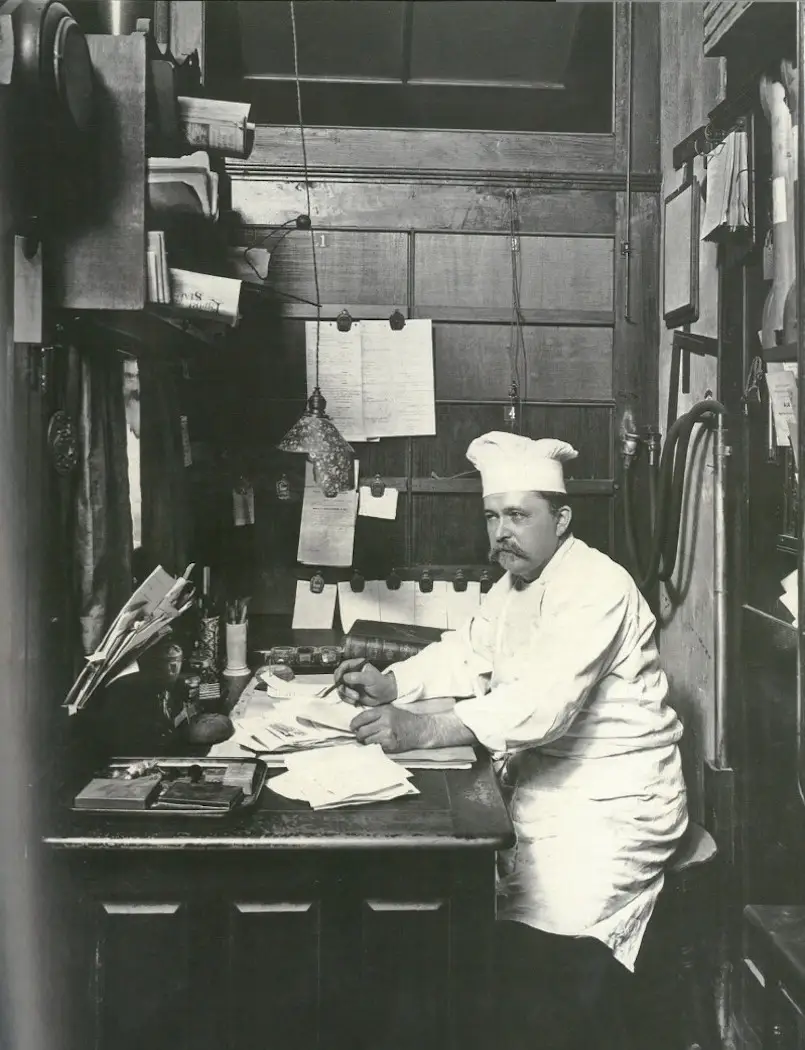
Ranhofer created his famous Eggs Benedict at Delmonico’s in 1860’s when a very regular customer Mrs. Le Grand Benedict, was looking for something new to eat for lunch. Ranhofer asked her for a few of her favourite things to eat, and he came up with a dish he called Eggs Benedict. He calls it Eggs a’ la Benedick in his cookbook, probably because he didn’t know the correct spelling of her name.
However, The Waldorf Hotel also in New York, a few miles away down 3rd Avenue, claim that it was created first by the Waldorf’s legendary maître d’ Oscar Tschirky, who wasn’t a chef but is credited as having invented the Waldorf Salad. The interesting thing here is that Tschirky was working at Delmonico’s under Ranhofer before he got the job as maître d’ at the Waldorf. The Waldorf’s story is that in 1894 a Wall Street broker Lemuel Benedict was suffering from a hangover and ordered ‘some buttered toast, crisp bacon, two poached eggs, and a hooker of hollandaise sauce’. This combination of ingredients was so unusual, but worked so well together that Tschirky was impressed, and put the dish on his breakfast and luncheon menus after substituting Canadian bacon for crisp bacon and a toasted English muffin for toasted bread.
The problem I have with that story is that Charles Ranhofer’s printed recipe for Eggs a’ la Benedick first appeared in his cookbook, The Epicurean, which was published a year earlier in 1893! So perhaps Oscar Tschirky was ‘so impressed’ with Ranofer’s Eggs a’ la Benedick that he, erm, borrowed it.

LOBSTER NEWBURG …
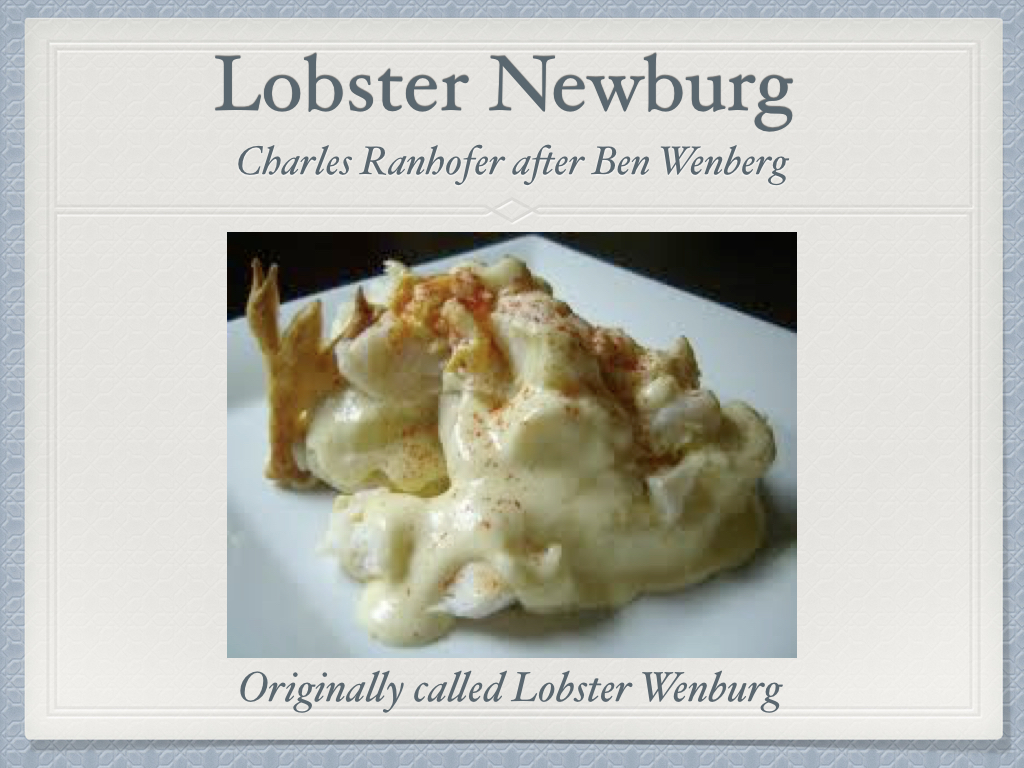
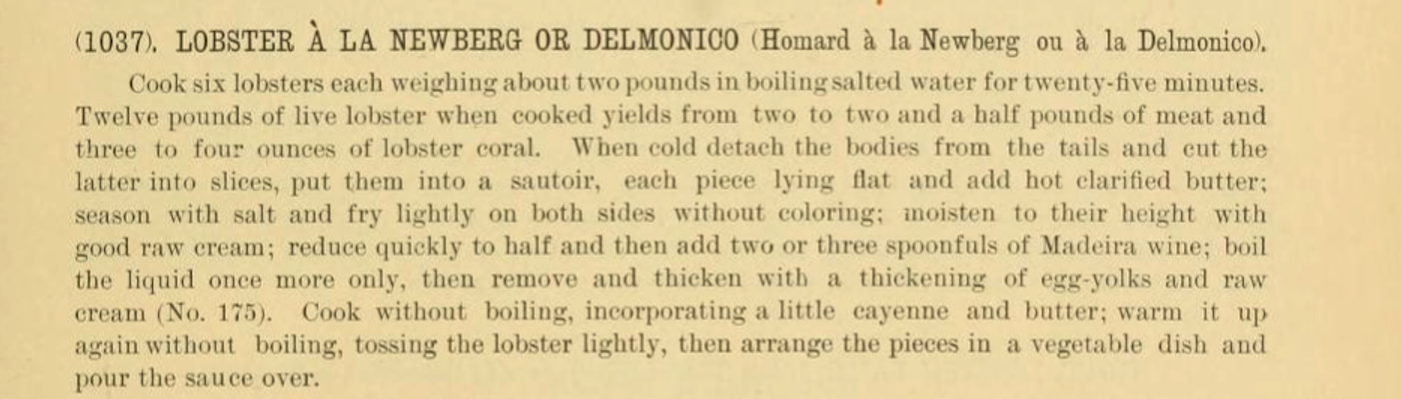
… is a dish Ranhofer developed, made from a freshly boiled lobster, the claw and tail meat sautéed in butter and flambeed with brandy and sherry. For the sauce, egg yolks are whisked together in warm cream, nutmeg, cayenne and the lobster meat is added to warm through and served over Melba toasts.
The dish was originally created in 1876 by Ben Wenberg, a sea captain in the New York fruit trade. He bought in a couple of fresh lobsters one afternoon and showed Ranhofer, his favourite way of cooking them. He liked the idea of the dish and, after making a few refinements, added it to the restaurant’s menu as Lobster à la Wenberg and it proved to be a very popular.
But there was a slight problem because Ben Wenberg was a rough, tough bar room brawler, who caused a few disruptions and after a fight in the restaurant Delmonico banned him – and the dish – from the menu. Unfortunately, by then it had become so popular that customers continued to ask for it, so they put it back on the menu but changed the name of the dish to Lobster Newburg which is an anagram of Wenburg. Ranhofer’s printed recipe first appeared in The Epicurean 1893.
BAKED ALASKA
According to historians in 1802, Thomas Jefferson was one of the first presidents to serve ice cream at a state banquet in the White House. As the story goes, Jefferson requested the ice cream to be served encased in a hot pastry. The idea was that the layers of pastry and the air space between the pastry crust and the ice cream would act as an insulation. I’m not convinced that it would have been very successful. In 1804, American physicist Benjamin Thompson Rumford discovered the insulating properties of trapped air in a cellular structure of foam which keeps the heat from reaching the ice cream, a forerunner of Adria Ferran’s molecular El Bulli restaurant, perhaps.
Ranhofer took this idea of trapping air, by using sponge cake and a meringue to act as the insulator, coupled with a high oven heat and a short cooking time prevented the heat from getting through to the ice cream. What he discovered was a new dessert, naming it ‘Omelette Surprise.’
Ranhofer coincided the creation to celebrate the USA purchase of Alaska from Russia, which was negotiated by New York Senator William Seward in Oct 18 1867. Buying Alaska was known as Steward’s Folly or Steward’s Icebox.
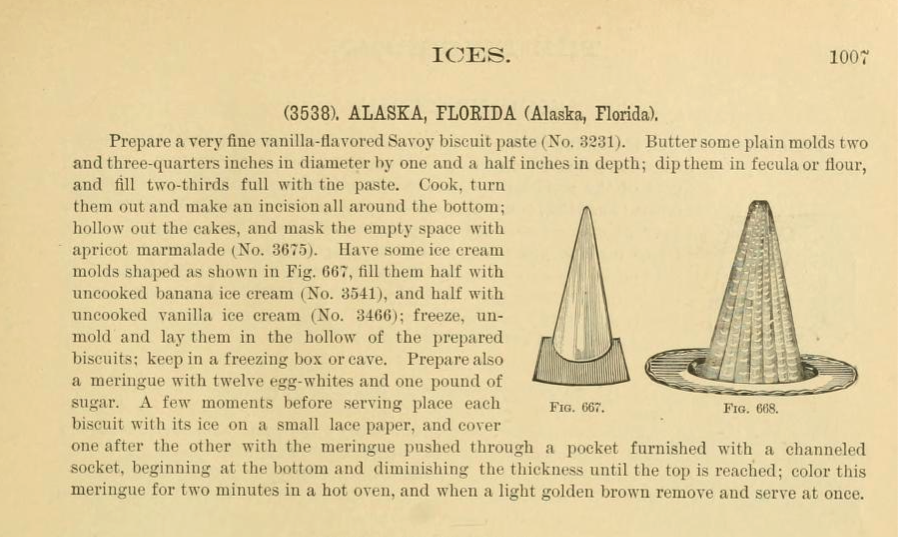
He originally made a vanilla flavoured savoy biscuit paste and filled a half moon baking mould. When cooked, he hollowed out the middle of the cake to leave a thin veneer, then spread apricot confiture inside the void and filled it, first with frozen banana ice cream, then vanilla ice cream then returned it to the freezer. In service, when ordered the cake was unmoulded and a meringue was prepared and piped around from the bottom to the top. It was placed in a very hot oven for two minutes until the merengue was golden brown. The meringue, thin layer of cake acts as an insulator for the two or three minutes, to prevent the ice cream from melting in the oven.
Ranhofer called the dessert at the time, Alaska-Florida, as in cold and hot, in the cookbook, The Epicurean.
The modern technique of making Baked Alaska is very different from the way Charles Ranhofer would have originally made it at Delmonico’s. Now days a restaurant cuts a disc of sponge cake that has been spread with raspberry jam, and centres it on a larger disc of baking paper. A frozen ball of vanilla ice cream is then placed on top of the jam spread sponge and returned to the freezer until needed. A meringue is made up with egg whites and caster sugar in a piping bag and kept in a fridge. It then becomes is a very quick dessert to get into service when ordered. You quickly pipe the cold meringue around the ball of ice cream and sponge and lift it – holding it by the baking paper, on to an oven tray and immediately placed into a very hot oven to bake until the meringue is golden brown. Sometimes chefs blow-torch the meringue, to burn it for speed to give it colour but I don’t like that method as it doesn’t cook the meringue properly and you end up with something that looks and tastes like burnt shaving cream.
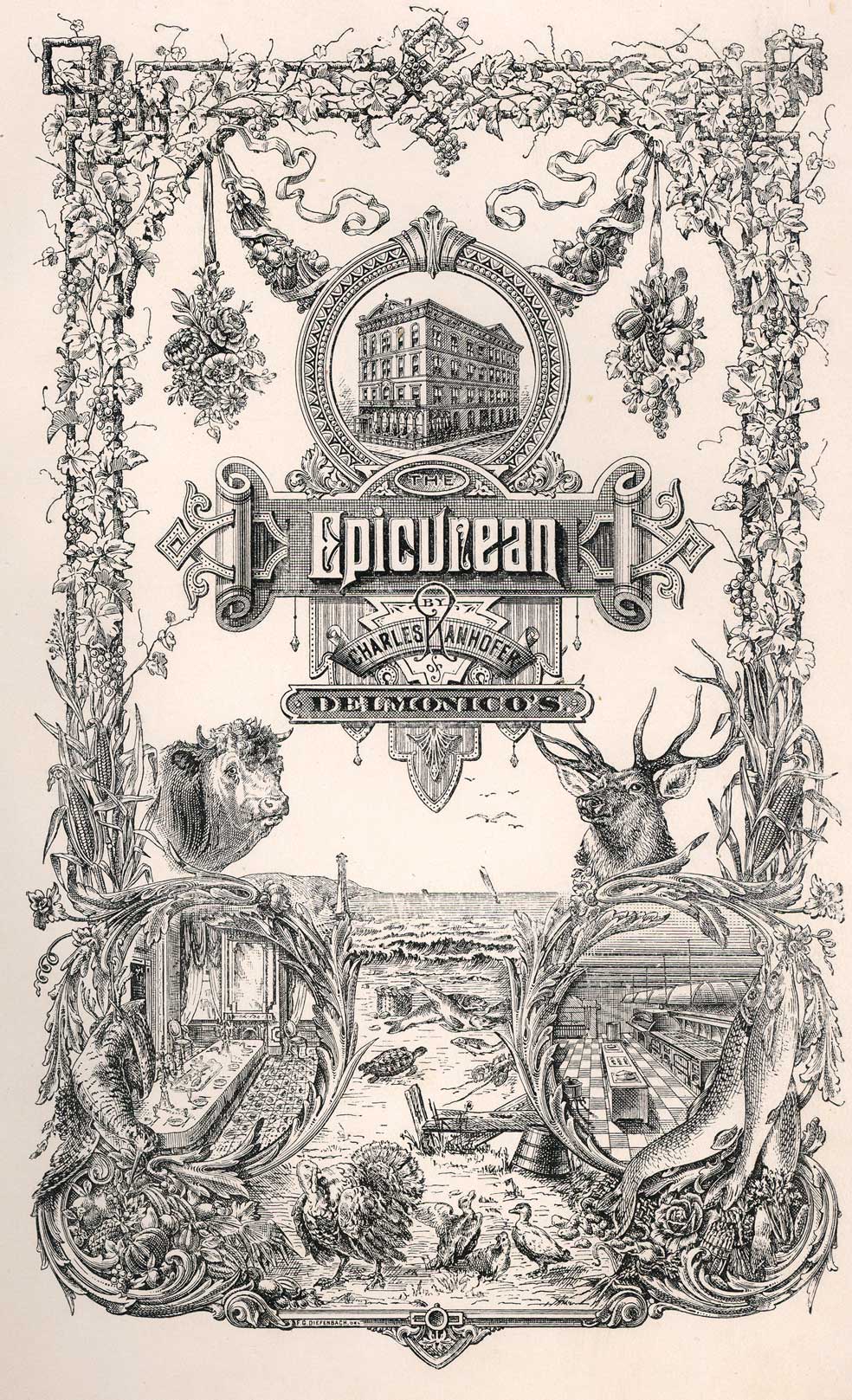
Charles Ranhofer would work for the Delmonico’s restaurant group for the next 35 years, retiring in 1898. He died relatively unknown. All we have is his magnum opus, the Epicurean, to remember him by.
Comments are closed.